
See also


 18.06.2026 09:31 AM
The Federal Reserve's decision to maintain interest rates at their current level reflects a complex balance between various economic factors. However, this does not prevent the U.S. dollar from strengthening its position against a number of risk assets.
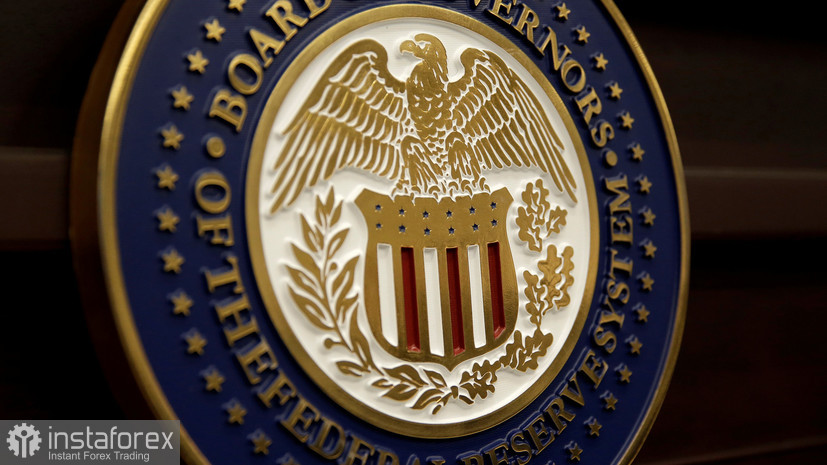
On the one hand, stable GDP growth and productivity, as well as a resilient labor market, provide reason to believe the economy is on solid ground. On the other hand, persistent inflation, fueled by geopolitical events and supply shocks, remains a serious problem.
The division of opinions among Fed officials regarding future rate hikes underscores the uncertainty of the situation. The median forecast, indicating a potential rate hike by the end of 2026, reflects the central bank's readiness to act decisively should inflation continue to accelerate. However, the presence of those predicting a rate cut shows a tendency towards gradual easing of policy as prices stabilize.
The removal of the phrase "additional adjustments" from the statement and the emphasis on "price stability" can be interpreted as a signal of a shift towards a more pragmatic approach, as recently warned by the new Fed Chair, Kevin Warsh. The Fed seems to acknowledge that a tight monetary policy alone is not a panacea for inflation driven by external factors, but also asserts that it is crucial for the central bank to be ready to adapt to changing conditions.
The Fed's recognition of the impact of the Middle Eastern conflict on economic activity and inflation indicates the increasing role of geopolitics in macroeconomic forecasting. Fuel shocks directly linked to these events exert significant pressure on prices, and preventing them from spreading more broadly to other sectors will be a key task for the central bank.
Overall, the Fed's decision is a cautious step reflecting the desire to maintain a balance between controlling inflation and supporting economic growth. Future actions will depend on the dynamics of both internal and external factors, as well as the Fed's ability to anticipate and respond to emerging risks. Given that Trump signed a memorandum for a ceasefire with Iran yesterday, this slightly reduces pressure on medium-term inflation, but Tehran has not responded immediately.
All of this suggests that the short-term prospects for rates remain uncertain, reflecting a complex economic landscape. The increase in the inflation forecast to 3.3% by the end of 2026, up from 2.7%, is a significant factor. This indicates that the Fed views inflation as being more persistent than previously thought and perhaps more difficult to tame. A cautious slowdown in the projected GDP growth also signals the central bank's acknowledgment of potential risks associated with high inflation and tightening monetary policy.
Regarding the current technical picture for EUR/USD, buyers need to focus on reclaiming the level of 1.1535. Only this will allow for a targeted test of 1.1565. From there, it may be possible to climb to 1.1590, but doing so without support from major players will be quite challenging. If the trading instrument declines near 1.1500, I expect significant actions from major buyers. If none are present, it could be wise to wait for a new low at 1.1480 or to open long positions from 1.1440.
As for the current technical picture for GBP/USD, pound buyers need to reclaim the nearest resistance at 1.3330. Only this will enable targeting 1.3365, above which it will be quite challenging to break through. The further target will be around 1.3390. If the pair declines, bears will attempt to take control of 1.3295. If they succeed, a breakout of this range will deal a serious blow to the bulls' positions and push GBP/USD down to a low of 1.3260 with the potential to reach 1.3225.


