
See also


 31.07.2026 04:00 AM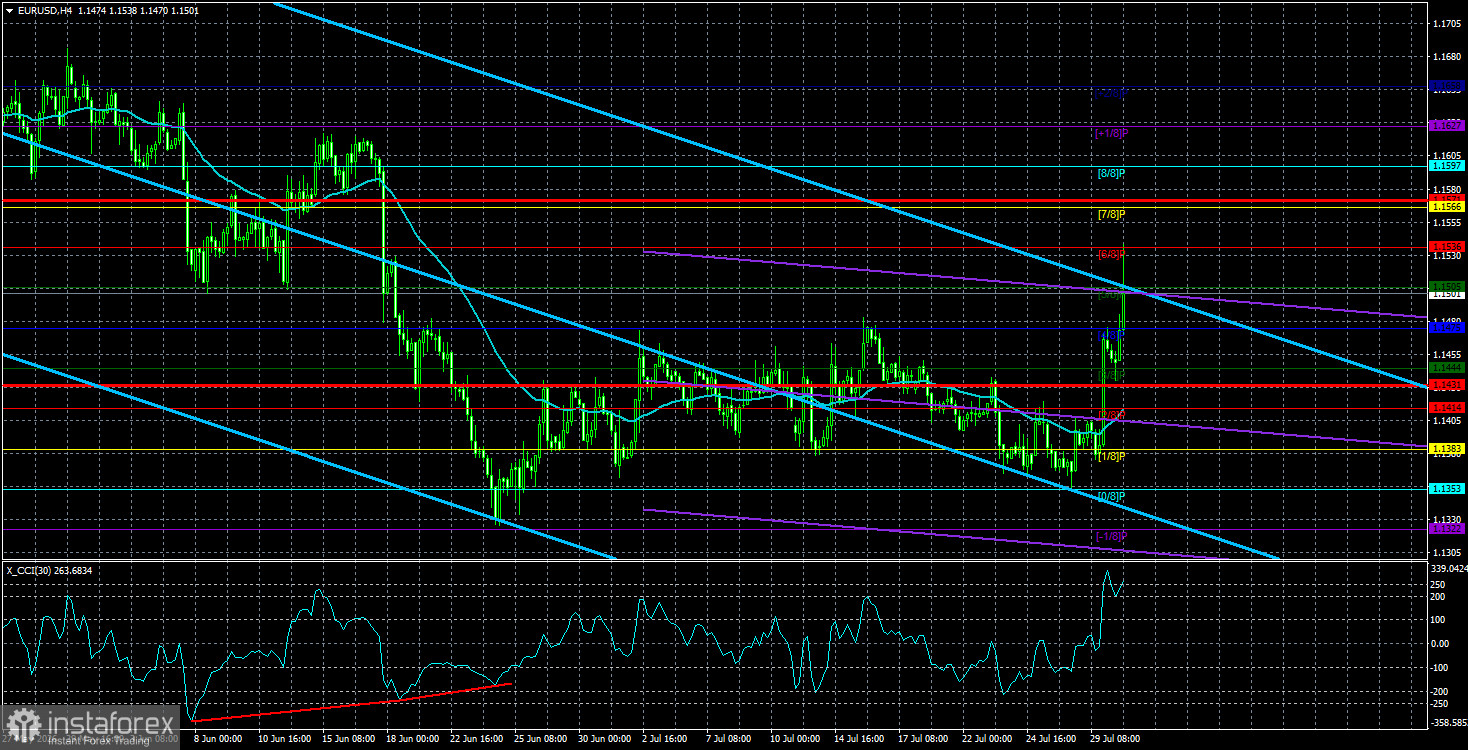
The EUR/USD currency pair demonstrated a strong upward movement on Wednesday evening and Thursday. In total, the euro gained about 150 pips, which is quite significant. However, it would be more accurate to say that "the dollar lost 150 pips." The American currency depreciated after the FOMC meeting, as Kevin Warsh's promises and hints were not enough to convince the market of a September monetary policy tightening.
Currently, a very interesting situation has developed around the dollar. On one hand, the American currency has either been rising or stagnating for the past month and a half. In other words, the market has not shown a strong desire to sell the dollar. Why? Because the Federal Reserve "definitely intends to raise the key rate." However, time goes on, and the Fed watches and talks about how high inflation is and that something needs to be done about it. What to do and when remains unclear. Essentially, Warsh and the team have only one path - tightening monetary policy. This means Warsh must raise the key rate a few months after Donald Trump appointed him as Fed chair. Trump, who wanted to fire Jerome Powell for a year and a half and dismiss half of the Monetary Committee in response to the refusal to lower the key rate.
We understand that not everything depends on Trump or Warsh. There are objective data that cannot be ignored. But at the same time, we believe that the new head of the Fed will make every effort to avoid tightening monetary policy. How? We do not know. Perhaps the Fed will begin to refer to the slowdown in NonFarm Payrolls. Perhaps they will change their inflation targets. Perhaps they will publish their own inflation forecasts indicating a decline in the medium term without raising rates. Perhaps they will wait for the conflict in the Middle East to end and for inflation to slow naturally. Therefore, in our opinion, the market is once again waiting for actions from the Fed that are destined not to materialize.
It is worth recalling that during times of monetary policy easing, the market expected twice as many rate cuts as actually occurred. The current situation is similar. The euro has made an excellent leap forward, which we have been waiting for in recent weeks while the market was in a flat. The growth of the pair this week may and should become the beginning of a new trend.
As for geopolitics, we see that the economy and fundamentals are beginning to outweigh it. The US has once again begun bombing Iran, so there is no hope for the conflict to end soon. However, the conflict between Iran and the US did not start yesterday or a month ago. The market has already come to terms with the idea that the "Middle Eastern turmoil" is serious and long-lasting. As long as the conflict continues, the dollar cannot rise. The world is learning to cope without oil from the Middle East or is seeking alternative ways to transport it.
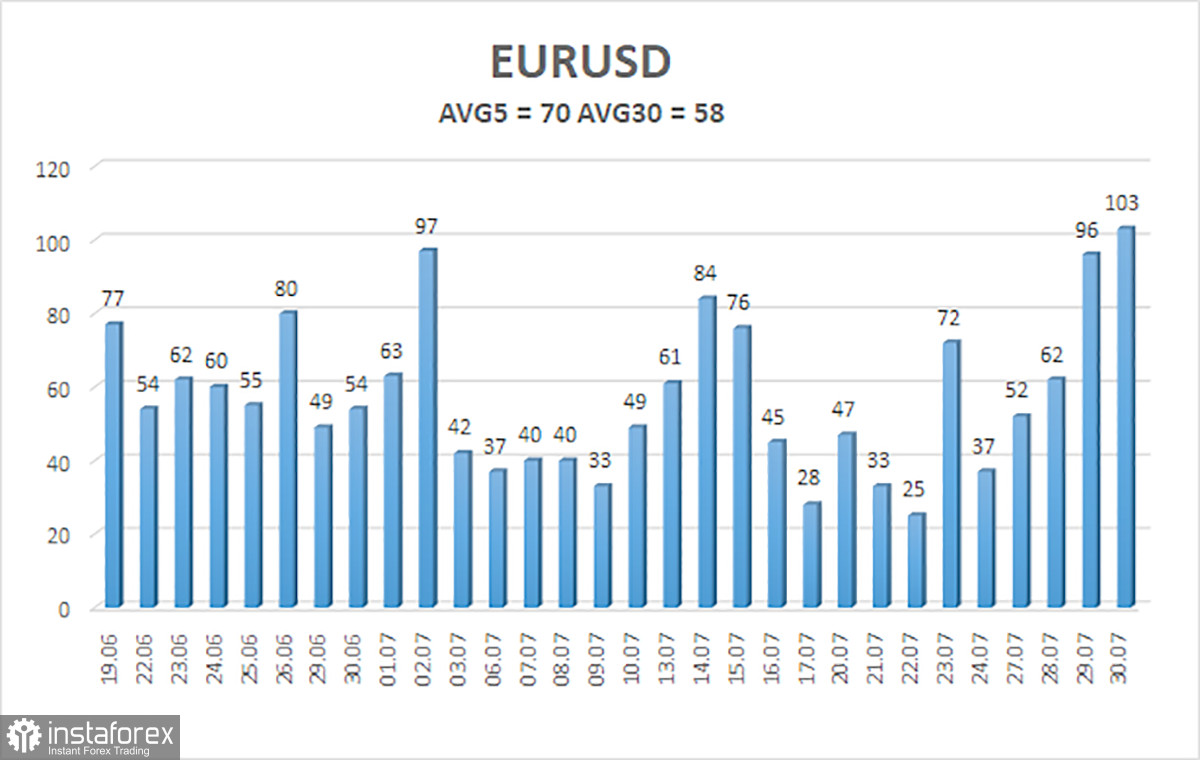
The average volatility of the EUR/USD currency pair over the last 5 trading days as of July 31 is 70 pips, which is considered "average." We expect the pair to move between 1.1431 and 1.1571 on Friday. The upper linear regression channel is directed downward, indicating the continuation of the bearish trend. The CCI indicator has entered the overbought zone, which now warns of a possible downward correction.
S1 – 1.1505
S2 – 1.1475
S3 – 1.1444
R1 – 1.1536
R2 – 1.1566
R3 – 1.1597
The EUR/USD pair maintains a bearish trend, presumably a correction within the broader upward trend, clearly visible on the daily or weekly time frames. The global fundamental backdrop for the dollar remains negative, but in 2026, both geopolitical factors and the Fed's hawkish mood provided strong support for the American currency. When the price is below the moving average, shorts can be considered with targets at 1.1383 and 1.1353. Above the moving average line, long positions are relevant with targets at 1.1566 and 1.1597.


