
Lihat juga


 10.03.2026 03:50 PM
For now, the market reaction should be considered moderate given the potential consequences if the war drags on. Markets are assuming no further escalation and that energy flows through the Strait of Hormuz will be restored. That stance is not based on a precise calculation but on the belief that a protracted crisis would be against everyone's interests and that some diplomatic solution may yet be found.
There are, of course, serious doubts. Iran has been attacked twice over the past year during negotiation periods, and after the killing of the country's leadership, hopes that Iran would accept US and Israeli actions have evaporated. A new phase of confrontation is beginning in which Iran will try to force the United States out of the region by methodically striking every military base it can reach.
Europe is in an extremely dangerous position. The situation is deadlocked, and excessive optimism is misplaced. ECB officials have even raised the possibility of an unscheduled rate increase to combat inflation, while simultaneously urging caution in forecasts—some clarity is needed. President Trump has attempted to reassure markets in his usual manner, insisting he is far from deploying troops to Iran, which under other circumstances might be laughable because the option is practically unavailable.
Although oil has pulled back from a peak near $119/bbl to a more acceptable $92/bbl, it is too early to relax, even if the US strategic reserves will cover the market for only a few days.
We assume that in the short term, there is little chance of EUR/USD resuming a sustained rise. Any attempted uptick amid soothing statements will be used as an opportunity for fresh selling.
The net long position in the euro fell by $3.3bn over the reporting week to $19.8bn. Although the bullish bias remains visible, the trend toward selling the euro has strengthened. This is most likely a reaction to the threat of interrupted energy supplies to Europe. The implied price has fallen sharply, and, at least in the near term, the direction is unlikely to change.
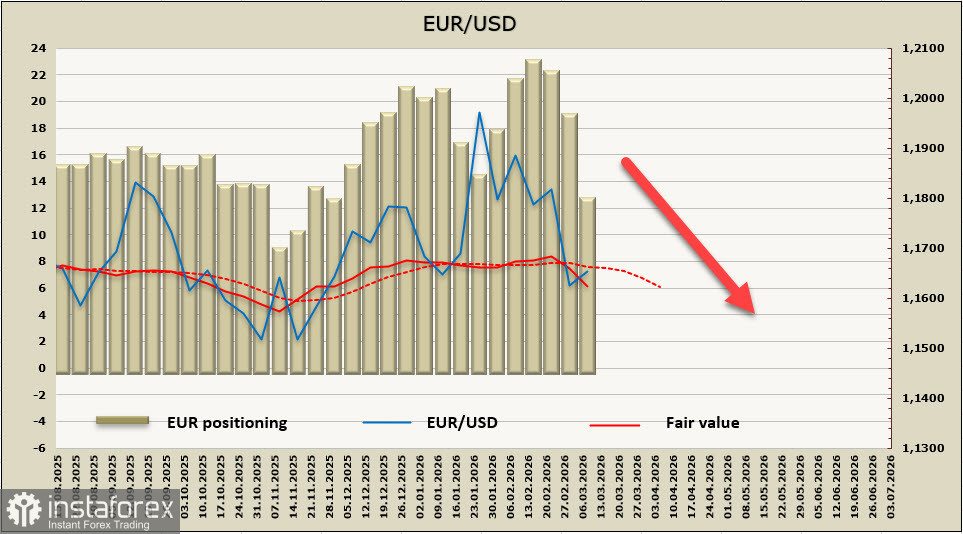
In our previous review, we expected trading to be largely range-bound while markets awaited clarity. Clarity arrived quickly, hence the market reaction. As long as the Strait of Hormuz remains closed, do not expect EUR/USD to resume a sustained advance. The market is currently pricing a non-protracted conflict with resumed supplies, so the euro's decline is likely limited, and it is unlikely to fall below the near-term support band 1.1460/1.1490 in the short run. Declines could resume if escalation intensifies; conversely, if there are signals that the war may end, an upward retracement is likely—immediate resistance would be around 1.1720/1.1730.


