
Lihat juga


 19.06.2026 12:47 AM
If all the information the Federal Reserve presented on Wednesday is accurate, the first round of tightening will begin as early as September. I don't know why specifically in September, especially since inflation is already exceeding the target mark by 2.2%, but the market consensus is that it will be in September. In my view, a lot can happen before September, and Kevin Warsh may change the FOMC's decision-making methodology during this time to achieve the most dovish policy, as Donald Trump desires. I believe that all changes implemented by Warsh are part of a strategy to alter the approach to monetary policy and align it with the White House's position.
Let's consider what the White House's response might be if the Fed begins raising rates ahead of the Congressional elections. A rate hike automatically implies that the economy will slow, spending and economic activity will decline, and investment will be constrained due to rising borrowing costs. The cost of auto loans, mortgages, and any other consumer loans will rise. And this is in a country where every first citizen has a credit card and lives on credit. It's important to understand that in America, credit is part of the economic philosophy. Americans work for years to establish a good credit history so that they can subsequently take out new, larger loans. If all loans become more expensive, dissatisfaction among the American populace ahead of the elections may intensify.
American consumers have already endured several unpleasant months with fuel prices 1.5 times higher than usual. Additionally, high fuel prices are driving up the cost of consumer goods and services. Last year, the White House, without batting an eye, collected between $150 billion and $300 billion from all Americans for imported goods. Therefore, the tightening of Fed policy is yet another nail in the coffin for the Republican Party ahead of the midterm elections.
For this reason, I believe Warsh faces a super-complex task of keeping rates unchanged despite high inflation. One could, for example, act by using a sort of "redefinition of terms." Recently, Donald Trump stated that he is completely satisfied with the current inflation and considers it "brilliant." So why can't the new Fed Chair promote a target inflation rate of 4%? The price stability that Warsh spoke of last night can also mean different things. A stable price growth of 4% per year could become the new target for the Fed. I believe the market has somewhat jumped to conclusions, expecting two rate hikes by the end of the year.
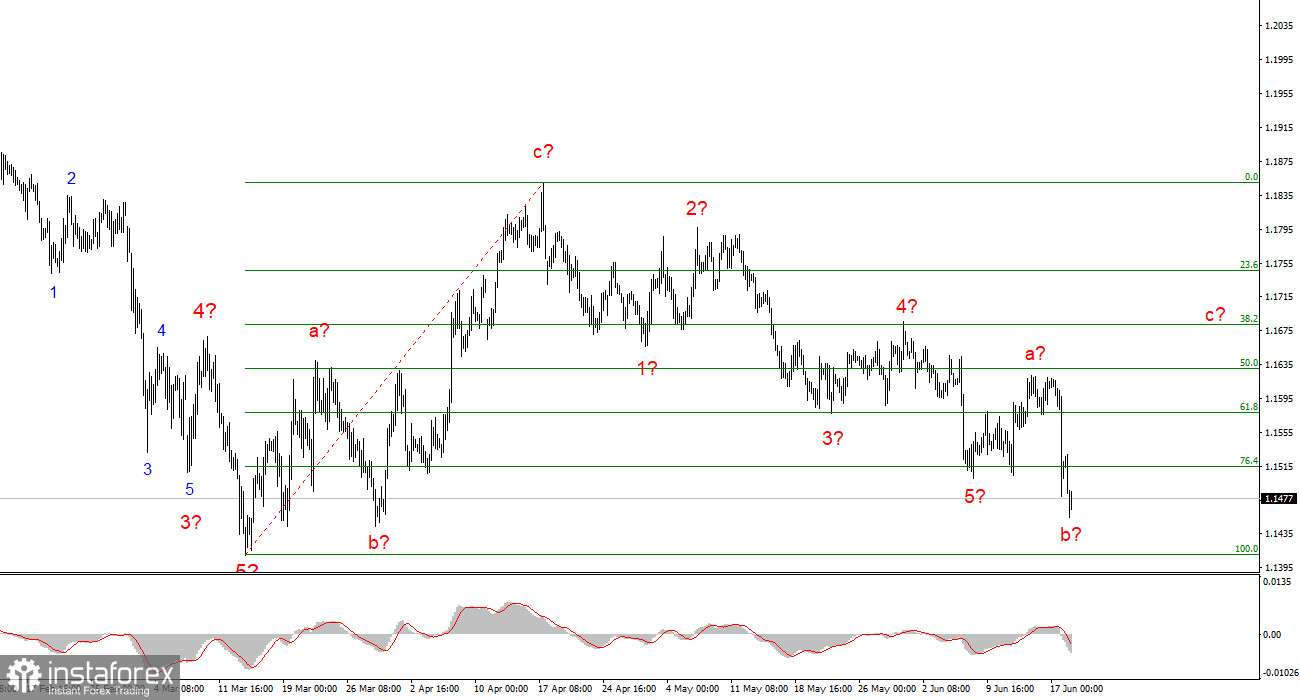
Based on the analysis of EUR/USD, I conclude that the instrument remains within an upward segment of the trend, while in the shorter term, it is within a downward segment of the trend that may be nearing completion. In my view, it is a good time to consider forming long positions, but the instrument could drop below the 14 figure within wave C. If this assumption holds true, it would be better to wait a bit. I also think the market will take into account that the ECB is tightening and that the geopolitical conflict in the Middle East has concluded.
The wave structure for GBP/USD has become clearer. Currently, the instrument has formed three waves down, while EUR/USD has formed five. Consequently, the British pound may limit itself to constructing a corrective structure, and both currency pairs may begin forming upward segments of the trend. At this moment, this is merely an assumption, but it is a probable one. If it is correct, the instrument will begin to rise with targets around the 35 figure and above. Market participants currently have a good opportunity to buy.


