
Lihat juga


 06.03.2026 07:32 PM
The EUR/USD pair was declining during the first two days of the week and has now been standing still for three days. If such movements on Wednesday and Thursday were understandable due to the weak news background, then just a couple of hours ago in the United States discouraging reports on the labor market and unemployment were released. Many traders felt a surge of optimism after the January Nonfarm Payrolls and unemployment reports, however I warned that it was too early to draw conclusions. January's figures turned out to be positive, which looked extremely strange and unusual. Throughout 2025, 181 thousand jobs were created in the United States, and by the results of January 2026 – 130 thousand. What suddenly revived the labor market? As the February data showed, it did not revive. All the more strange is the reaction of traders to American statistics, which at the time of writing the article was practically absent. Bullish traders did not become more active, and the dollar did not experience any shock.
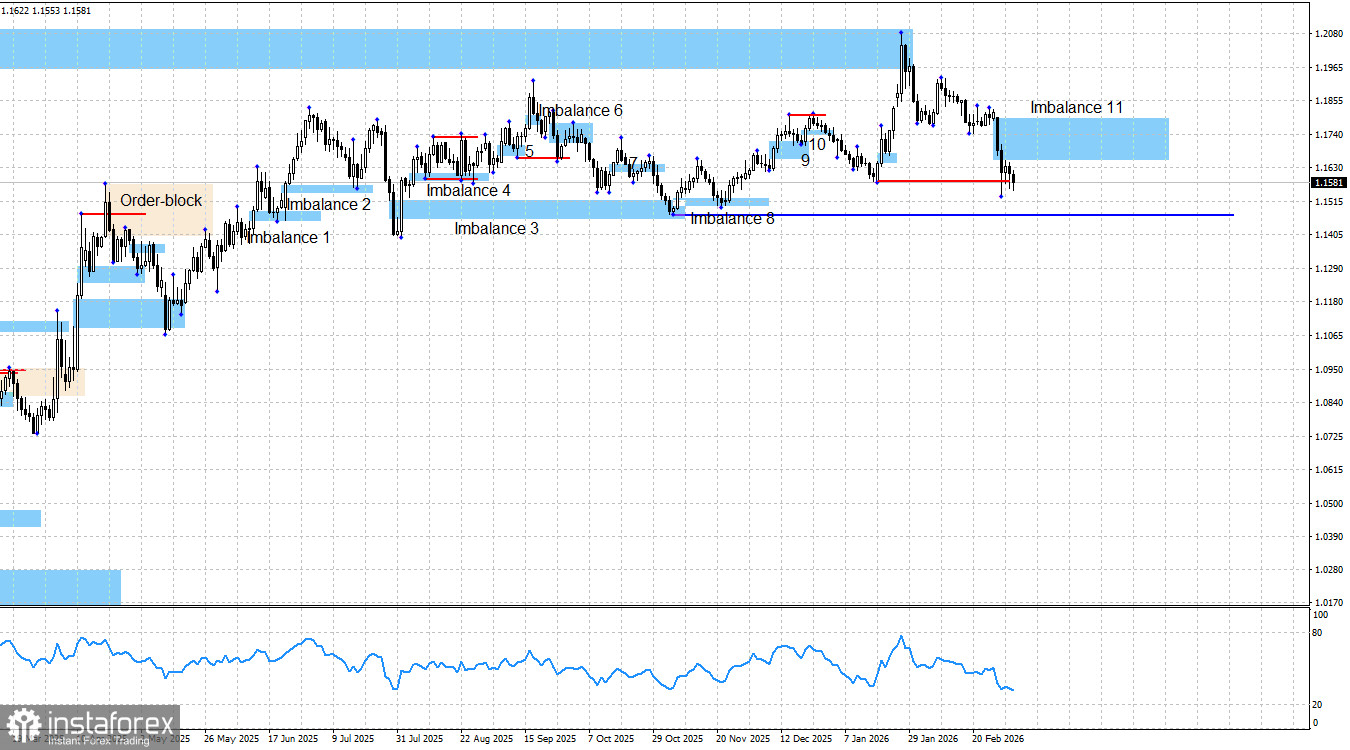
This week, as expected, a "bearish" imbalance 11 was formed. However, the trend still remains "bullish," and Tuesday ended with a liquidity grab from the swing of January 19. I remind you that a liquidity grab is not a pattern from which positions can be opened. It is only a warning of a possible shift in market sentiment. Thus, traders face a choice: either wait for a bearish signal within the bullish trend, or wait for a break of the bullish trend and only then work with bearish patterns, or wait for bullish patterns.
The graphical picture continues to signal bullish dominance for now. The bullish trend remains, however at the moment the bullish scenario has been postponed for an indefinite period. In order to once again expect growth of the European currency, new bullish patterns are required.
Friday's news background was extremely interesting. As I already mentioned, the Nonfarm Payrolls report showed a value that could make all dollar supporters' hair stand on end. In February, the number of jobs in the United States decreased by 92 thousand. For me, however, such a value of the key labor market indicator is not surprising at all, since I do not see what could revive the labor market. The unemployment rate rose to 4.4%, which none of the traders expected either. However, the bears did not begin to retreat, and the bulls did not begin to attack. The market ignored the most important statistics.
In recent months, bulls have had a huge number of reasons to attack, and even with the beginning of the war in the Middle East their number has not decreased. Structurally and globally, the policy of Donald Trump, which led to a serious fall of the dollar last year, has not changed. In the near future, the American currency may show growth due to investors fleeing from risk, but this factor will not be able to support it for long. At the same time, the dovish prospects of monetary policy from the Federal Open Market Committee, Trump's trade war with the whole world, the weakness of the American labor market, two government shutdowns, U.S. military aggression, criminal prosecution of Jerome Powell, declining GDP growth rates, and other unpleasant developments for America are not canceled by the conflict in Iran.
I still do not believe in a bearish trend. The dollar has received temporary support from the market, but it is far from certain that this situation will persist for a long time. The blue line shows the price level below which the bullish trend could be considered finished. Bears need to push the price down about 140 points to reach it, and even if they manage to do so, I will still doubt the bearish trend. In my opinion, the pair is showing a strong decline only because of the geopolitical factor. When it stops influencing the market, what will bears rely on to attack? Bearish patterns may form this week, and then the local picture will be easier to analyze and forecasts will be easier to build.
News calendar for the United States and the Eurozone:
On March 9, the economic calendar contains only one secondary entry. The influence of the news background on market sentiment on Monday will be absent. Friday showed that the market does not want to sell the dollar under any circumstances.
EUR/USD forecast and advice for traders:
In my opinion, the pair remains at the stage of forming a bullish trend. The news background sharply changed direction last weekend, but the trend itself remains. Thus, in the near future traders need new patterns and signals to form short-term forecasts. If these are bearish signals (which is more likely), it is important to remember that the trend remains bullish, and the geopolitical factor usually does not have a long-term impact. If these are bullish signals (which is much more preferable), traders will have the opportunity to open new buy positions that do not contradict the trend.


