
Lihat juga


 12.06.2026 01:35 PM
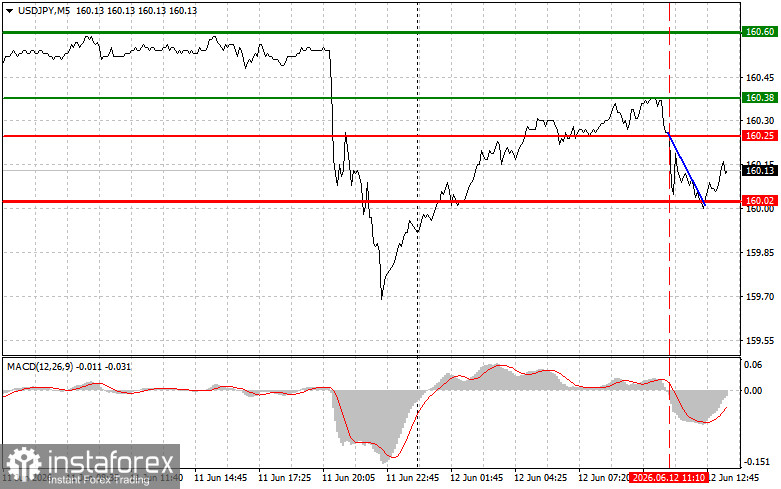
The price test at 160.25 occurred at a moment when the MACD indicator had just started moving downward from the zero line, confirming a valid entry point for selling the dollar. As a result, the pair declined toward the target level of 160.02.
Given the tense situation surrounding possible intervention by the Bank of Japan in the yen exchange rate, traders are tending to adopt a more cautious, wait-and-see approach. In the near term, the University of Michigan Consumer Sentiment Index and inflation expectations data are expected, which could trigger a spike in market volatility. However, attention is likely to remain focused on developments in the potential peace settlement between the United States and Iran.
Despite uncertainty regarding the specific terms of a possible agreement, the very fact that active negotiations are taking place is already having a noticeable impact on the market, reflected in yen buying against the dollar and a decline in USD/JPY.
For the intraday strategy, I will rely more on scenarios #1 and #2.
Buy Signal
Today, I plan to buy USD/JPY at an entry point around 160.22 (green line on the chart), targeting a rise toward 160.60 (thicker green line). At 160.60, I will exit long positions and consider opening short positions in the opposite direction (expecting a 30–35 point reversal). Any upward movement in the pair today is only likely in the case of strong U.S. data. Important: before buying, ensure that MACD is above the zero line and has just started rising from it.
Buying USD/JPY is also considered if there are two consecutive tests of 159.98, while MACD is in oversold territory. This would limit downward potential and trigger a reversal upward. In this case, a move toward 160.22 and 160.60 can be expected.
Sell Signal
I plan to sell USD/JPY after a break below 159.98 (red line on the chart), which would trigger a quick decline in the pair. The key target for sellers is 159.70, where I will exit short positions and immediately consider buying in the opposite direction (expecting a 20–25 point reversal). Selling pressure may return in the case of central bank intervention. Important: before selling, ensure that MACD is below the zero line and has just started declining from it.
Selling USD/JPY is also considered if there are two consecutive tests of 160.22, while MACD is in overbought territory. This would limit upward potential and trigger a reversal downward. A decline toward 159.98 and 159.70 can be expected.
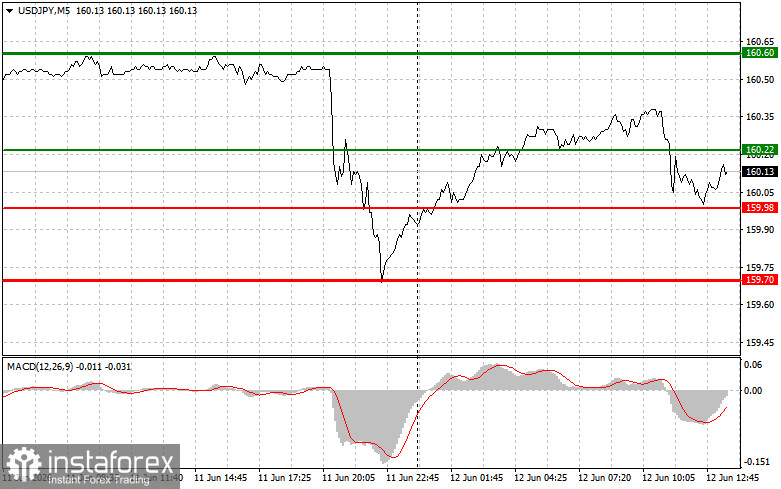
Chart Explanation
Important Notice
Beginner Forex traders should make entry decisions very cautiously. Before major fundamental releases, it is best to stay out of the market to avoid sharp volatility. If you decide to trade during news releases, always place stop-loss orders to minimize losses. Without stop-loss orders, you may lose your entire deposit very quickly, especially if you do not use proper money management and trade large volumes.
Remember that successful trading requires a clear trading plan, similar to the one presented above. Making spontaneous trading decisions based on current market conditions is, by definition, a losing intraday strategy.


