
Veja também


 19.12.2025 12:47 AM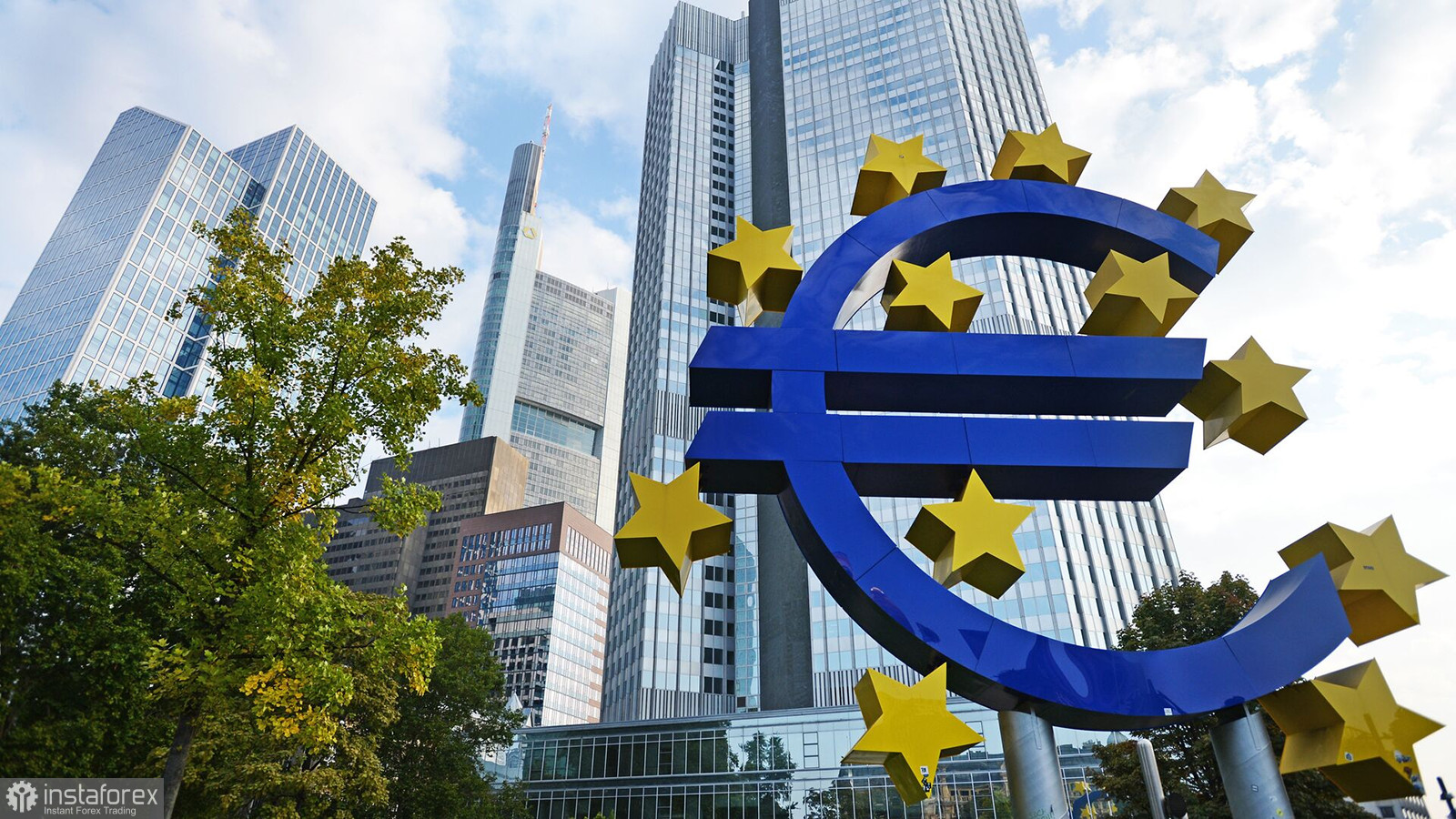
On December 18, the European Central Bank concluded its final meeting of the year, albeit a week later than the Federal Reserve. As expected by market participants, no significant decisions were made. All three interest rates (refinancing, deposit, and lending) remained unchanged for the fourth consecutive time. The ECB's accompanying statement emphasized the resilience of the European economy. The 2025 growth forecast was revised upward to 1.4% year-on-year. While such growth rates cannot be deemed high, they are stable, which the ECB likely finds satisfactory.
The statement also noted weaknesses in the manufacturing sector (particularly in Germany), while concurrently highlighting a strong labor market and robust domestic consumption. The eurozone economy has responded well to Donald Trump's trade war, with initial expectations of much worse outcomes from tariffs. Nevertheless, economic growth persists, inflation has been stabilized around 2%, and there are no imminent risks of it accelerating. The ECB continues to prioritize maintaining price stability.
The final communique indicated that the central bank will continue to monitor any changes in economic processes closely and is prepared to react if necessary. This means that if inflation deviates from 2% on a sustained basis, the ECB will be ready to tighten or ease monetary policy. One of the ECB's executives, Isabel Schnabel, previously highlighted the risks of high inflation over the risks of an economic slowdown. The market interpreted this statement as a signal that the ECB might consider raising interest rates next year. On the other hand, another ECB executive, Luis de Guindos, reminded that it is important not only to prevent a new rise in the consumer price index but also to avoid slowing down below the target mark. Thus, the ECB may also revert to easing.
From all this, it follows that the ECB does not need to change its monetary policy parameters in the coming months. Therefore, we do not expect changes, nor do we anticipate the ECB's decisions to significantly impact the euro's exchange rate. The EUR/USD instrument will likely be more influenced by U.S. news, particularly Fed decisions, in the coming months.
Based on the analysis, I conclude that the EUR/USD pair continues to build an upward trend segment. Donald Trump's policy and the Fed's monetary policy remain significant factors influencing the long-term decline of the American currency. The targets for the current segment of the trend may extend to the 25 figure. The current upward wave set is beginning to develop, and I hope we are witnessing the construction of an impulsive wave structure that is part of the global wave 5. In this scenario, we should expect growth to reach the 25 figure, as I mentioned earlier.
The wave structure of the GBP/USD pair has changed. We continue to deal with an upward, impulsive trend segment, but its internal wave structure has become more complex. The downward corrective structure a-b-c-d-e in C of 4 appears complete, as does the entire wave 4. If this is accurate, I expect the main trend to resume construction with initial targets around the 38 and 40 figures.
In the short term, I anticipated the formation of wave 3 or c with targets around 1.3280 and 1.3360, corresponding to the 76.4% and 61.8% Fibonacci retracement levels. These targets have been achieved. Wave 3 or c continues to build, and the current wave set is beginning to show impulsive characteristics. Therefore, we can expect continued upward pricing with targets around 1.3580 and 1.3630.


