
Vea también


 10.03.2026 12:53 PM
The banking community has launched a bitter fight against regulatory policies that, in their view, place traditional financial institutions at a structural disadvantage.
According to sources, the Bank Policy Institute (BPI), which represents the interests of 40 of the largest US banks including JP Morgan, Goldman Sachs and Citigroup, is weighing all options after the Office of the Comptroller of the Currency (OCC) ignored repeated warnings from influential banking groups and state regulators about revising federal licensing rules.
Large US banks, clearly worried about competition from more nimble crypto and fintech firms, are prepared to aggressively challenge recent OCC decisions to grant streamlined charters. Bankers argue these licenses enable fintech and crypto entrepreneurs to operate nationally, provide banking?like services, and yet avoid the strict regulatory requirements incumbent banks must meet.
Their complaint boils down to unequal playing fields. Banks say years of investment in compliance, security and consumer protection are now at risk. The new rules, they contend, create a regulatory loophole allowing new market entrants to capture dominant positions without bearing proportionate risks or costs. That, in turn, could weaken financial stability and reduce protections for millions of American depositors.
The lawsuit banks are preparing aims to secure equal application of regulatory standards. They insist any firm offering financial services — regardless of its technological niche — should be subject to the same level of supervision. This is intended to prevent systemic risks associated with the unchecked growth of non-bank financial intermediaries that lack adequate reserves and risk management frameworks.
Banks' stance is also backed by broader concerns about the economy. They foresee that relaxed oversight of new players could spur unfair competition, degrade service quality and ultimately erode trust in the financial system. In this context, litigation is seen as a last but necessary step to defend the established order and ensure the sustainable development of the US financial sector.
If the courts do not take the banks' claims seriously, it would be a major victory for the cryptocurrency industry. But don't expect a quick resolution — recall how long the SEC's proceedings against Ripple lasted.
Trading recommendations
Bitcoin
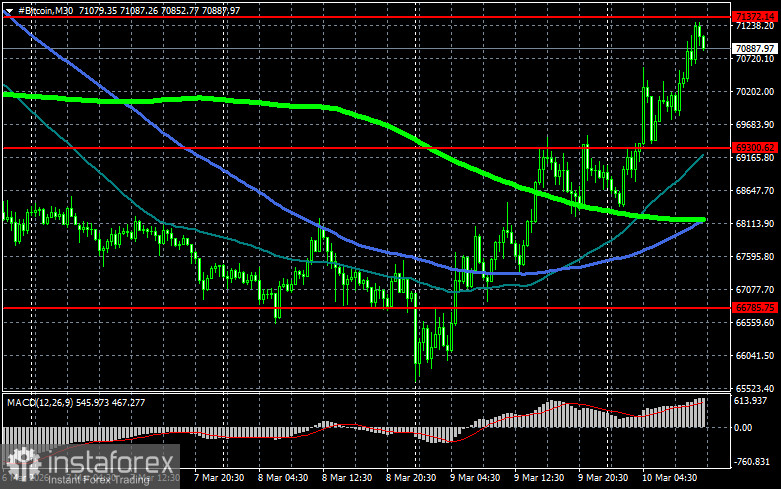
Buyers are currently targeting a return to $71,300, which would open a direct path to $73,000 and then $74,600. The most distant upside target is the high near $77,400; a break above that would signal attempts to resume the bull market. On the downside, buyers are expected at $69,300. A move back below that area could quickly push BTC toward $66,700, with a further downside target near $64,900.
Ethereum
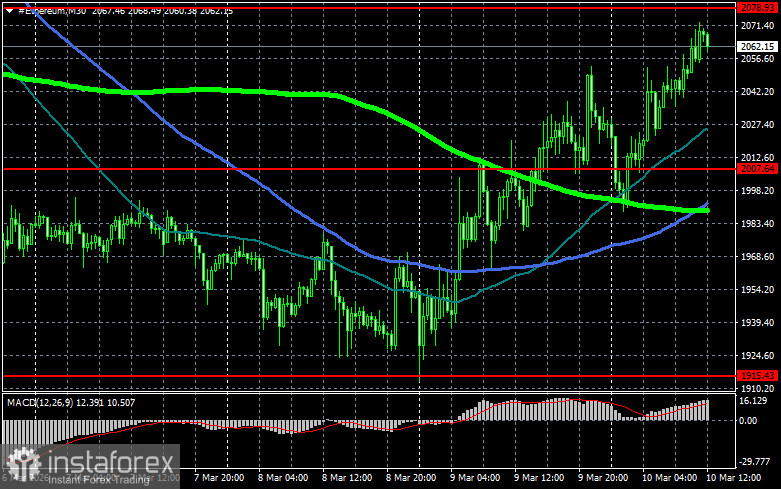
A clear close above $2,078 would open the way to $2,169. The most distant upside target is the high near $2,279; a break above that would indicate strengthening bullish sentiment and renewed buyer interest. On the downside, buyers are expected at $2,007. A move below that area could quickly send ETH toward $1,915, with a further downside target near $1,845.
What's on the chart
Price testing or crossing any of these moving averages often either halts movement or injects fresh momentum into the market.


