
Vea también


 24.06.2026 06:36 PM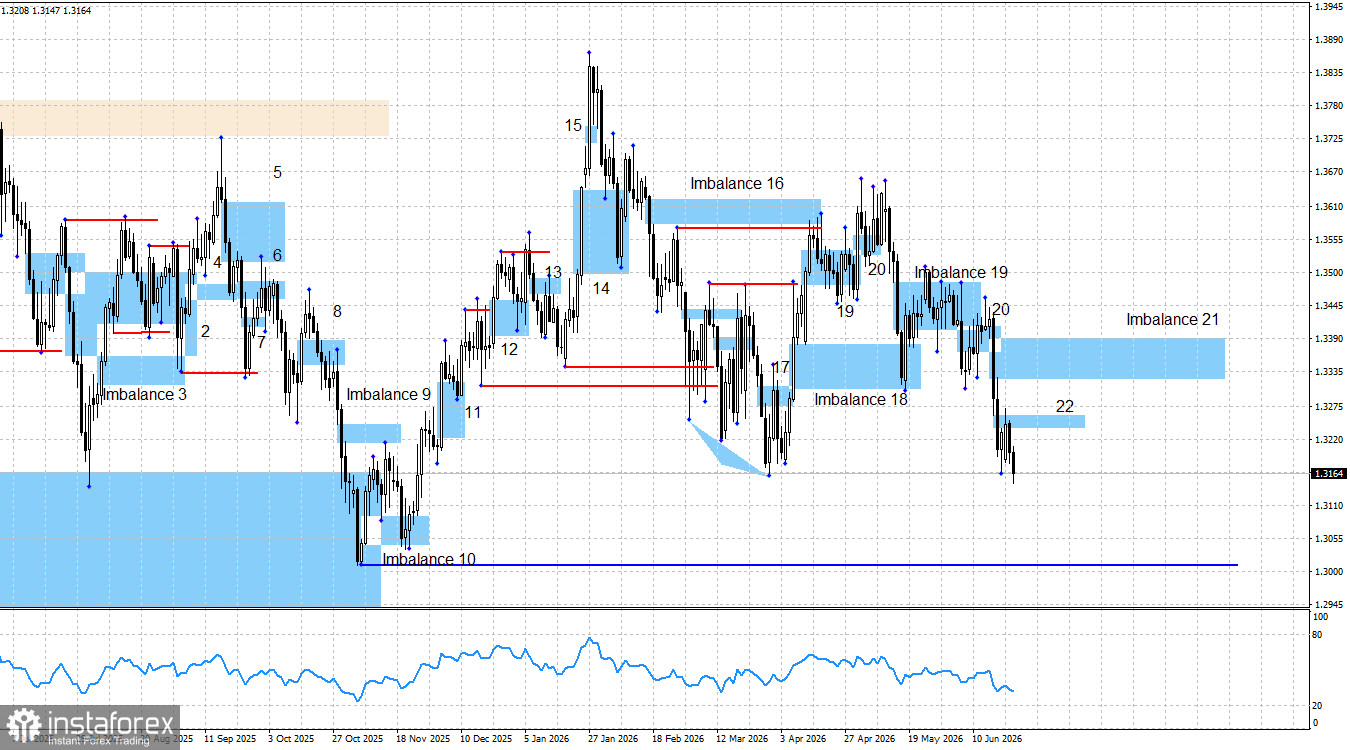
The GBP/USD pair continues to move lower overall. On Monday, the bulls received a glimmer of hope when the British pound strengthened following reports of UK Prime Minister Keir Starmer's resignation. However, Monday quickly gave way to Tuesday, and market reality returned. That reality is that the U.S. dollar continues to appreciate regardless of the surrounding circumstances.
The Federal Reserve adopted a surprisingly hawkish stance a week ago, but an entire week has already passed since that event. The geopolitical conflict in the Middle East has ended, the Strait of Hormuz has reopened, and oil prices have almost returned to pre-conflict levels. Yet none of these factors have had any noticeable impact on either traders or the dollar. The current situation appears contradictory: on the one hand, there is a strong trend; on the other hand, there is no clear explanation for why this trend exists.
A sell signal was generated yesterday, but it appeared only because of the pound's rise on Monday. In other words, almost by chance. Personally, I view the current bearish wave as an anomaly rather than a fundamentally justified move. The market continues to open long positions in the dollar, and no one can prevent it from doing so. However, it is extremely difficult to explain why market participants continue to open sell positions on GBP/USD day after day. Nevertheless, there are no signs that the bears' advance is ending, and a new sell signal emerged yesterday.
The U.S. currency traditionally performs better during periods of geopolitical uncertainty than either the euro or the pound. Therefore, both European currencies could still receive support if risk appetite continues to improve. At present, the market remains cautious regarding the agreement between Iran and the United States and is waiting for the full reopening of the Strait of Hormuz, which is not an easy task in itself. However, it can at least be said that the conflict has officially ended—or, at the very least, is moving toward a resolution.
The Federal Reserve triggered a strong rally in the U.S. dollar, but I still do not understand what is driving the bears to continue their attacks. In my view, the broader trend remains bullish despite the sharp declines seen in GBP/USD this year, which have not always been supported by convincing fundamentals.
From a technical perspective, the picture is currently as follows. Last week, a new bearish imbalance (No. 21) was formed. A reaction to this pattern may provide traders with opportunities to open short positions. However, at the moment, the pound can only dream of reaching imbalance 21. The market reacted to the nearer imbalance 22 instead. Once again, I would emphasize that a move lacking a clear fundamental basis can end at any moment—and unexpectedly.
It is also worth noting the proximity of the March 31 swing low, which could serve as a liquidity target. If liquidity is taken below that low, the bulls may begin a counteroffensive based on the overall combination of factors. For now, however, the local technical picture remains bearish.
There was no meaningful economic news on Wednesday, making it difficult to explain the latest decline in the pound. No major events or reports were released. Regardless of how far the pound may fall, if the reasons behind the move remain unclear, I prefer to maintain my original view that the broader bullish trend has not yet ended.
The overall fundamental backdrop remains such that, in the long run, I continue to expect weakness in the U.S. dollar rather than strength. The conflict between Iran and the United States has not fundamentally changed that outlook. Neither has the possibility of a Federal Reserve rate hike in 2026.
Geopolitical tensions temporarily reminded the market of the dollar's safe-haven status, but the conflict has ended—or is at least moving toward resolution. The Federal Reserve's intention to raise interest rates in 2026 is undoubtedly a positive factor for the dollar. However, tighter monetary policy would also slow the U.S. economy. Moreover, Kevin Warsh was appointed by Donald Trump to lead the FOMC not for the purpose of aggressively raising interest rates.
I believe that any future tightening by the Federal Reserve, if it occurs, would be temporary and aimed at quickly reducing inflation. Afterward, the U.S. central bank would likely return to a more accommodative policy stance. Therefore, in my view, any appreciation of the dollar should be regarded as temporary. Nevertheless, traders should not ignore the technical picture, which currently points to a high probability of further declines over the coming weeks.
News Calendar for the United States and the United Kingdom:
The economic calendar for June 25 contains four releases, although only the GDP report is likely to attract significant market attention. Economic data could influence market sentiment during the second half of Thursday's session, but the current decline appears to be driven by factors other than economic statistics.
GBP/USD Forecast and Trading Tips:
From a long-term perspective, the outlook for the pound remains bullish. However, the reaction to bearish imbalance 22 has triggered another wave of selling pressure. As a result, a new sell signal was generated this week. Since GBP/USD has been trading in a broad sideways range for nearly a year (on the weekly chart), the current decline can be explained primarily by technical factors. Within a range-bound market, price movements can develop in virtually any direction.
At present, there is no convincing explanation for the dollar's strength, which suggests that the market is experiencing a technical move within a horizontal trading range. The pound may decline as far as the bullish trend invalidation level at 1.3007. The main argument in favor of the bulls is the proximity of the 1.3158 low, which may serve as a liquidity target before a potential reversal.


