
আরও দেখুন


 30.07.2026 07:36 PM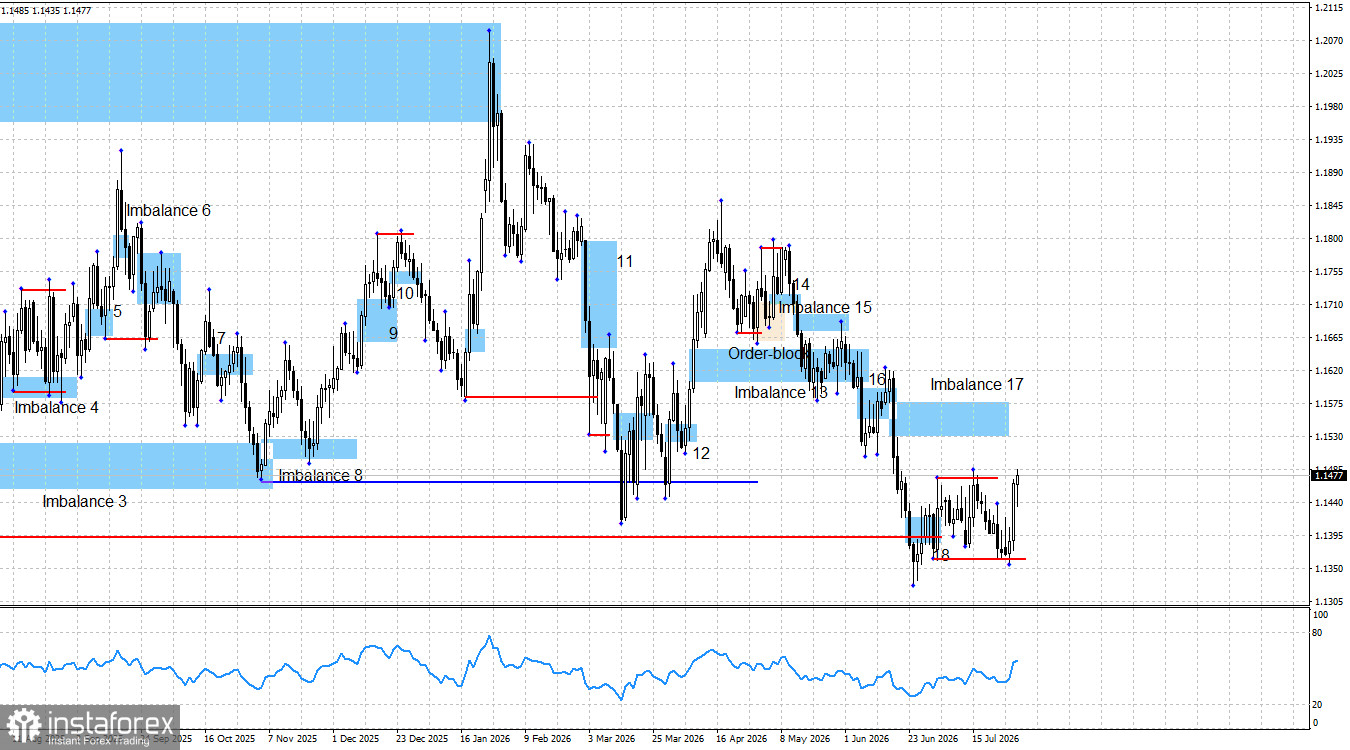
The EUR/USD pair has remained within a local bearish impulse since April 17, while price movements over the past four weeks have been minimal. Only in the past couple of days has the market shown more notable activity, driven largely by the Federal Reserve meeting. As a reminder, on Wednesday evening Kevin Warsh once again highlighted the problem of elevated inflation in the United States but was not sufficiently convincing when explaining the central bank's next steps. Traders expected Warsh to deliver, if not an outright promise of a September rate hike, then at least more hawkish rhetoric that would clearly answer the question: Is the Federal Reserve prepared to tighten monetary policy this autumn? Instead, Warsh referred to incoming economic data, and as we all know, the latest labor market figures were rather weak. As a result, in September Warsh may simply argue that labor market conditions do not allow the Federal Reserve to raise interest rates. Consequently, the bulls received unexpected support, completed another liquidity sweep, and should now begin the advance that I have personally been expecting for the past month. If the euro does not post a sharp decline by the end of today's session, a new bullish imbalance will be formed. A bullish imbalance is already a signal of potential upward movement—better than having no signal at all.
It is worth remembering that expectations of Federal Reserve monetary tightening remain nothing more than market expectations. The latest US labor market data came in relatively weak, while the inflation report showed a slowdown in price growth. Therefore, slowing employment and easing inflation raise doubts that the FOMC will raise interest rates in the foreseeable future. Personally, I doubt that the Federal Reserve will necessarily begin tightening policy this year, and even if it does, I believe it would likely be a one-off move intended to avoid provoking Donald Trump too much.
Geopolitics remains a secondary factor. Tehran and Washington have withdrawn from the June 17 agreement, but this development came as no surprise to traders. Donald Trump reinstated sanctions on Iranian oil and restored the blockade of Iranian shipping, while Iran once again closed the Strait of Hormuz and has been attacking vessels attempting to pass through what it considers unauthorized transit. A month ago, we did not see the anticipated decline in the US dollar following the easing of geopolitical tensions, nor did we see the euro appreciate after the ECB tightened monetary policy about six weeks ago. The bears remain in control despite the fundamental and geopolitical backdrop. At present, geopolitical developments continue to disappoint euro bulls, giving bears formal grounds for renewed selling pressure. In my view, strained relations between Iran and the United States alone are no longer sufficient to justify another bearish offensive.
The current technical picture continues to point to the bearish impulse that began on April 17. Bearish Imbalance 17 has yet to be tested, while Imbalance 18 was invalidated following weak US labor market data. A new bullish imbalance may form today, which, together with the two recent buy-side liquidity sweeps, could become the starting point for a new bullish advance. In my opinion, the market has already priced in the possibility of Federal Reserve tightening while continuing to ignore the ECB's increasingly hawkish stance.
Thursday's economic calendar was packed with important releases. Although most of the attention was focused on the Federal Reserve, it is also worth noting that Germany's second-quarter GDP exceeded expectations, as did second-quarter GDP for the euro area. In addition, Germany's annual inflation accelerated from 2.3% to 2.8%, rather than to the expected 2.7%. As a result, inflation accelerated again in July, providing grounds to expect another round of ECB monetary tightening in September. The economic data favored the euro, inflation favored the euro, and the Federal Reserve meeting ultimately worked against the US dollar.
The bulls still have plenty of reasons to launch a sustained advance in 2026, and the conflict in the Middle East has done little to diminish them. Structurally and fundamentally, Trump's policies—which led to a significant decline in the US dollar last year—have not changed. At present, I see few meaningful sources of support for the US currency despite the FOMC's hawkish stance. Nevertheless, the bears remain on the offensive, while bullish technical signals are still absent.
July 31: The economic calendar includes two scheduled releases, with the Eurozone inflation report being the key event. Therefore, macroeconomic data may influence market sentiment on Friday.
In my view, the pair remains in the process of forming a bullish trend. Although the fundamental backdrop shifted sharply in favor of the bears five months ago, the broader trend cannot yet be considered invalidated or complete. Therefore, the bulls may well launch another advance following the two recent liquidity sweeps below clearly defined lows. However, opening long positions at the current stage would be impractical, risky, and technically unjustified. Any assumption without technical confirmation amounts to little more than speculation. There are currently no bullish patterns on the chart. Only today's daily close may produce a new bullish imbalance. If that happens, traders will have a clearly defined zone from which to consider long positions. The euro still has numerous upward targets, while the bears currently have only Bearish Imbalance 17 at their disposal.


