
See also


 06.07.2026 04:48 AM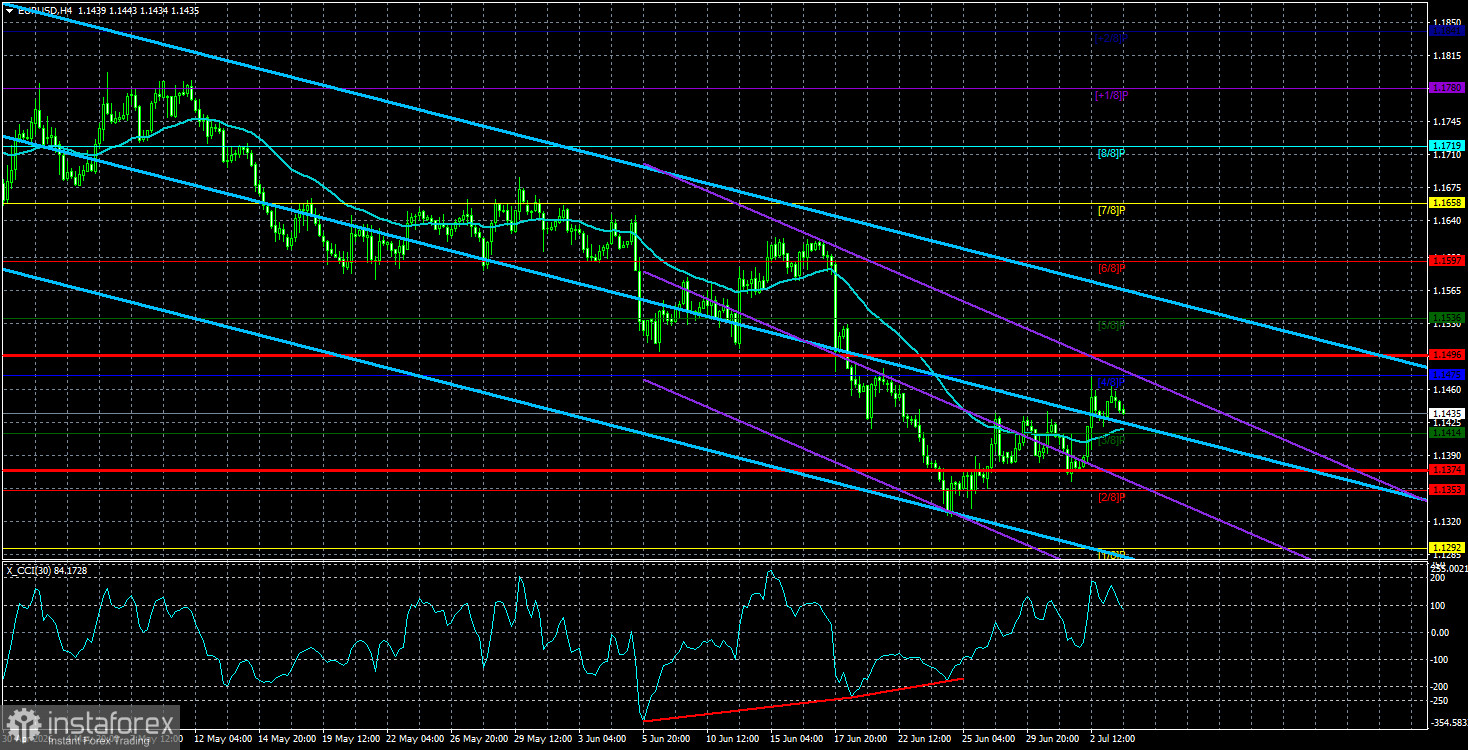
The EUR/USD currency pair continued its very weak recovery within a two-month downward trend on Friday. In fact, the weak movements on Friday are not surprising, as it was a holiday in the U.S. in honor of Independence Day. Thus, the 42 pips of volatility were expected. Overall, last week, the European currency managed to demonstrate only one strong movement and a more or less strong recovery—on Thursday, when the infamous Nonfarm Payrolls report was released in America.
Recall that the key U.S. labor market report came in twice as weak as forecasts, and the figures for the previous two months were revised downward. Thus, it can be said with complete confidence that the U.S. labor market is again experiencing problems. This means that we may hear a much more cautious rhetoric from Federal Reserve representatives in the near future, and Kevin Warsh has a very strong trump card in his hands. If the labor market slows down again, the Fed cannot afford to raise the key rate.
Moreover, it is necessary to first understand how inflation will behave in the new geopolitical realities. After all, the Strait of Hormuz is open, and oil prices have returned to pre-war levels. As such, American inflation may slow in the coming months. If so, we first need to determine how much inflation will decrease on its own and then assess the risks and feasibility of tightening monetary policy. We believe that if the Fed does tighten policy, it will not be until the winter of 2026-2027.
What does all this mean for the European currency? Essentially, nothing. The U.S. dollar has been rising over the past two months, as if the war in the Middle East were ongoing and the Fed had already started raising the key rate. The market continues to ignore most fundamental and geopolitical factors, especially those that favor the euro. Even the dollar's decline last week in the wake of weak Nonfarm Payrolls essentially changed nothing. The dollar fell, but it did so quite weakly, and the pair's upward movement looks like yet another correction before a new drop.
Thus, while we do not see reasons for further strengthening of the American currency, that does not mean the market cannot continue to buy it. The movement can be illogical, inertial, speculative, and purely technical. On the daily timeframe, we see a classic three-wave correction, and the price remains below the critical line. Therefore, even technical grounds for the euro's growth are currently very limited.
In the upcoming week, there will be very few fundamental and macroeconomic events that could support the euro. In our opinion, given the current market sentiment, the euro may only be saved by the market itself, which may simply tire of buying dollars without justification. We cannot predict further dollar growth, as there are no grounds for it. We also cannot predict the euro's rise, as the market has been buying only dollars for two months.
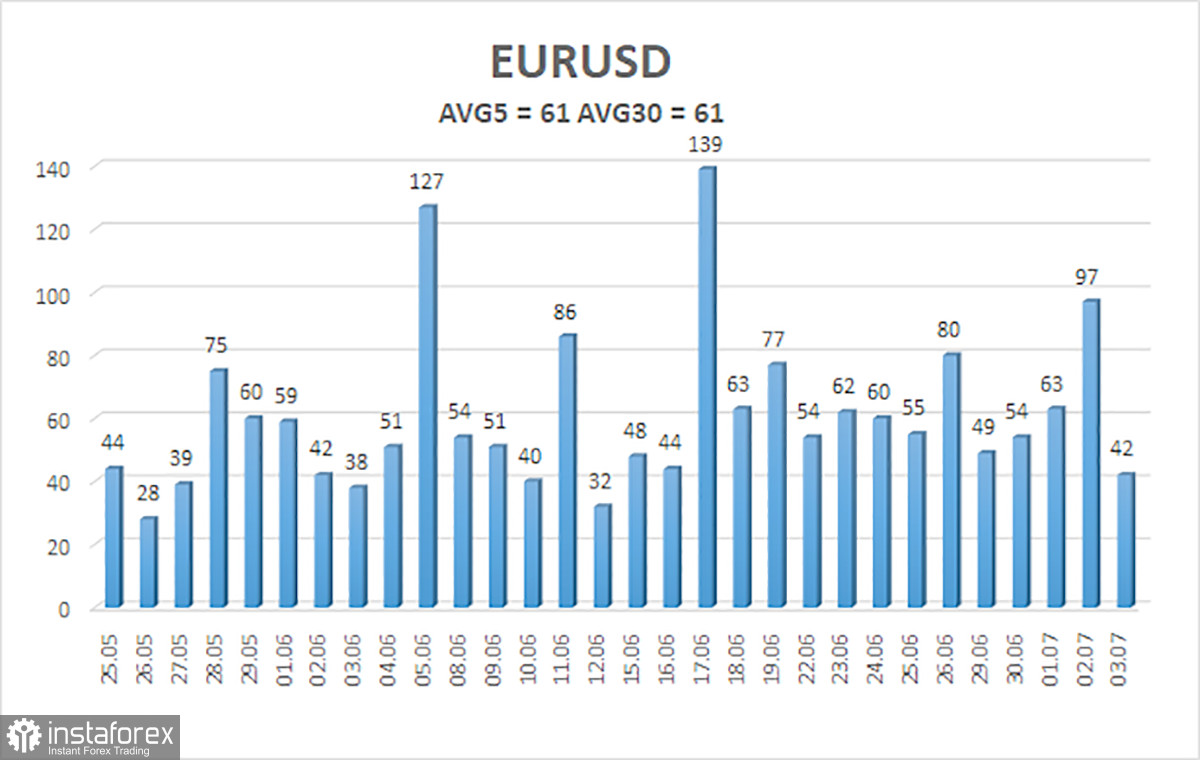
The average volatility of the EUR/USD currency pair over the past five trading days as of July 6 is 61 pips and is characterized as "average." We expect the pair to move between 1.1374 and 1.1496 on Monday. The upper channel of the linear regression has turned downward, indicating a continuation of the downward trend. The CCI indicator has entered the oversold area and formed two bullish divergences, signaling a potential end to the downward trend.
The EUR/USD pair maintains a downward trend, presumably a correction within a broader upward trend, as seen on the daily and weekly timeframes. The global fundamental background for the dollar remains negative, but in 2026, firstly geopolitics and then the Fed's hawkish stance have provided significant support for the American currency. When the price is below the moving average, short positions can be considered with targets at 1.1353 and 1.1292. Above the moving average line, long positions are relevant with targets at 1.1475 and 1.1496. Bears are currently very strong for no visible reason.


