
یہ بھی دیکھیں


 27.07.2026 05:04 PM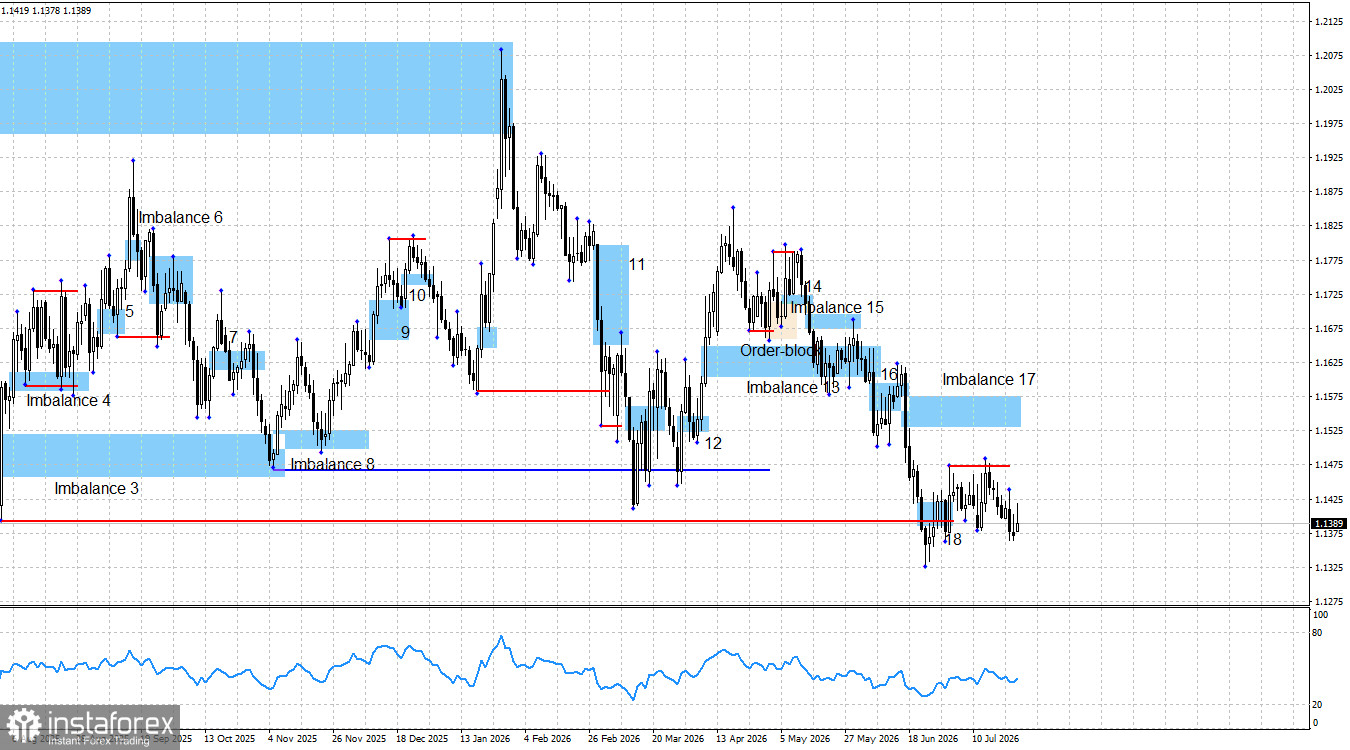
The EUR/USD pair remains within the local bearish impulse that began on April 17, while over the past four weeks bulls have only managed to push bears back slightly. The latest liquidity sweep warned of a high probability of a renewed decline, which is what we have been observing for more than a week already. It is difficult to determine how strong and prolonged the new decline will be, but bears have one key reference point — the latest swing low at 1.1325. A liquidity sweep from this swing could give bulls a second chance.
Regarding the fundamental background, I still do not see a clear reason why bears remain so strong. Geopolitics continues to disappoint, but this factor is unlikely to be the key driver for traders, as they barely reacted to the temporary ceasefire and the reopening of the Strait of Hormuz. The ECB decided last week to leave monetary policy parameters unchanged, but is that really a reason to sell the euro? I would like to remind you that the FOMC still cannot decide to raise interest rates, and it remains unclear when it will do so. The market completely ignored all economic data last week. Therefore, in my view, bulls simply have no desire to launch an attack, regardless of what happens.
I would also like to remind you that the latest US labour market data showed rather weak figures, while the inflation report indicated a slowdown. Therefore, the weakening of the US labour market and inflation growth are casting doubt on the possibility of an FOMC rate hike in the foreseeable future. Under the current circumstances, bears cannot justify their position through Fed policy.
Geopolitics remains a secondary factor. Tehran and Washington withdrew from the agreement of 17 June, but this fact did not surprise traders at all. Donald Trump cancelled permission for Iranian oil exports, restored the blockade on Iranian shipping, while Iran once again closed the Strait of Hormuz and attacked all vessels attempting to cross it "not according to the rules". We did not see the "promised" dollar decline amid easing geopolitical tensions a month ago, nor did we see the euro rise after the ECB's monetary policy tightening a month and a half ago. Bears remain strong despite the fundamental and geopolitical background. At present, geopolitics is once again causing disappointment, giving bears formal grounds for new attacks. However, in my opinion, this is no longer sufficient for a sustainable bearish advance.
The current chart structure indicates that the bearish impulse that began on April 17 remains intact. The bearish imbalance from the 17th has not been filled, while the imbalance from the 18th was invalidated due to weak US labour market data. No bullish patterns have formed, and they are unlikely to appear in the coming days, as the market has been moving sideways for a month. Therefore, bulls may continue a corrective move higher towards the imbalance from the 17th, but there is currently no clear basis for trading this movement.
A liquidity sweep was made from the low of August 1 last year (red line on the chart), and shortly afterwards a liquidity sweep was made from the high of July 2. Therefore, bears currently have technical reasons to launch new attacks. However, there are no bearish patterns either.
The economic background did not play a decisive role for traders on Monday. Germany's business climate index is a secondary indicator, while in the morning the market was focused on developments related to the temporary suspension of the conflict in the Middle East. Iran and the US have become exhausted from exchanging strikes, so a pause has been taken in an attempt to return to negotiations. The Durable Goods Orders report also failed to attract significant trader attention. The dollar's position did not deteriorate following the Middle East developments.
There are still numerous reasons for bulls to attack in 2026, and even the conflict in the Middle East has not reduced their number. Structurally and globally, Trump's policy, which led to a significant decline in the dollar last year, has not changed. At present, I do not see any significant factors supporting the US currency, despite the hawkish stance of the FOMC. Nevertheless, bears continue to lead the attacks, while there are still no bullish signals.
The economic calendar for 27 July contains two releases that are not of particular interest. At the moment, bullish traders are ignoring all news, while bearish traders continue their attacks without fundamental support. The impact of the economic background on market sentiment on Tuesday will be extremely weak or absent.
In my opinion, the pair remains in the process of forming a bullish trend. The fundamental background changed sharply in favour of bears five months ago, but the trend itself cannot be considered cancelled or completed. Therefore, bulls may well begin a new advance after a liquidity sweep from clearly defined lows.
However, opening buy positions at the moment is not advisable, is unsafe, and there is simply no clear technical basis for doing so. Any assumptions without technical confirmation are merely attempts to predict the market without sufficient justification. There are currently no bullish patterns.
Bearish traders have only one technical advantage at their disposal — the bearish imbalance from the 17th, which still remains unfilled.


