
Lihat juga


 06.08.2026 12:09 AM
Despite the pessimistic forecasts at the beginning of the year, the Canadian economy is showing signs of acceleration. In the second quarter of 2026, growth is expected to be around 2.5% year-on-year, significantly stronger than the zero dynamics in the first quarter.
In May, real GDP grew by 0.3%, exceeding analysts' forecasts of 0.2%. This marks the second consecutive month in which the economy has shown positive dynamics. The Bank of Canada notes that the strengthening of the economy is quite broad-based.
May retail sales data were strong, with a 1.0% monthly increase. Although part of this growth was driven by high gasoline prices due to the Middle Eastern conflict, sales increased across all major categories of goods. Preliminary estimates for June also indicate a 0.4% rise in sales.
While the unemployment rate fluctuates within this range, pointing to an oversupply in the labor market, the situation is gradually improving.
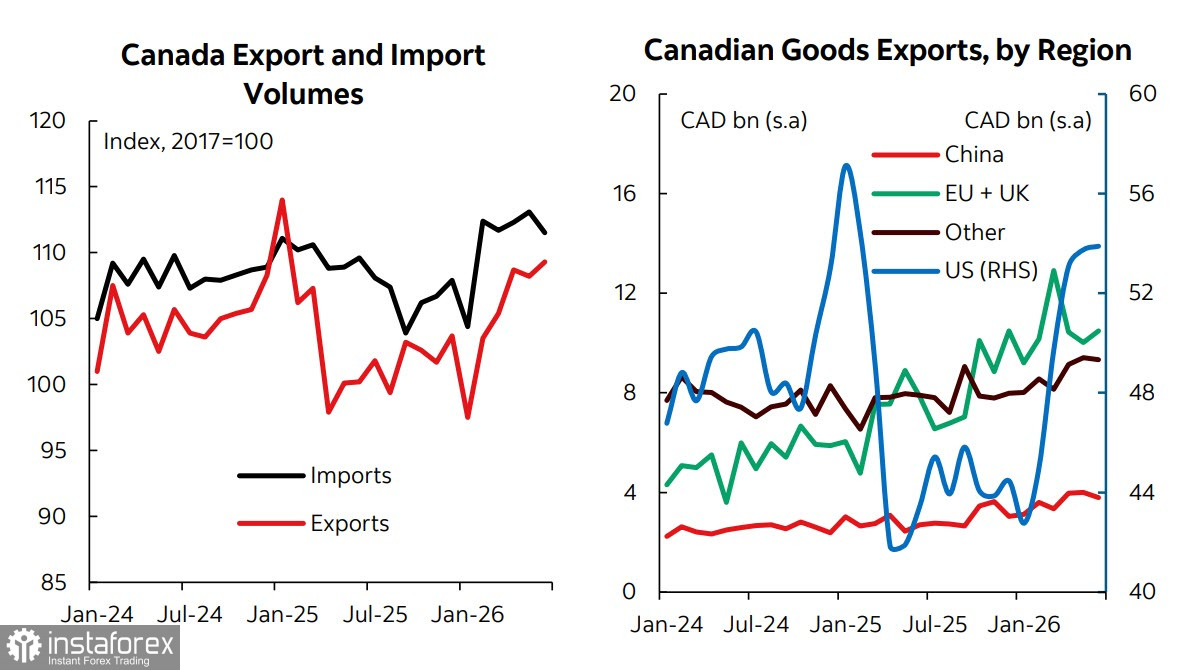
The main threat to the Canadian economy remains the escalation of the trade conflict with the U.S., which consistently ranks as Canada's largest export market. The planned implementation of a 50% tariff on Canadian goods worth approximately C$28 billion on August 19 creates significant uncertainty. Although oil, potash fertilizers, and critical minerals have been excluded from the new tariffs, the impact on other sectors could be substantial.
Against this backdrop of conflicting signals, the Bank of Canada maintains a wait-and-see position. The key rate remains at 2.25%, and markets are virtually certain that this level will be maintained at the September meeting (with a probability of a pause estimated at nearly 97%).
The key report on business activity in the U.S. services sector—the ISM Services PMI for July—showed 54.1 points, significantly above the 50 mark. Business activity accelerated sharply (+3.7 points to 59.1) — a positive signal for the U.S. economy — and the rise in the price index to 70.3 directly indicates continued strong inflationary pressure, adding arguments in favor of maintaining a tight Federal Reserve policy. This supports the dollar.
The Fed meeting on July 29 led to a weakening of the U.S. dollar against the loonie. The initial reaction has already smoothed out, and the probability of two Fed rate hikes by the end of the year has dropped to 42%.
The net short position on CAD increased by $0.9 billion during the reporting week, reaching -$13.1 billion, a record level over the past two years. The calculated price has lost momentum and looks neutral.
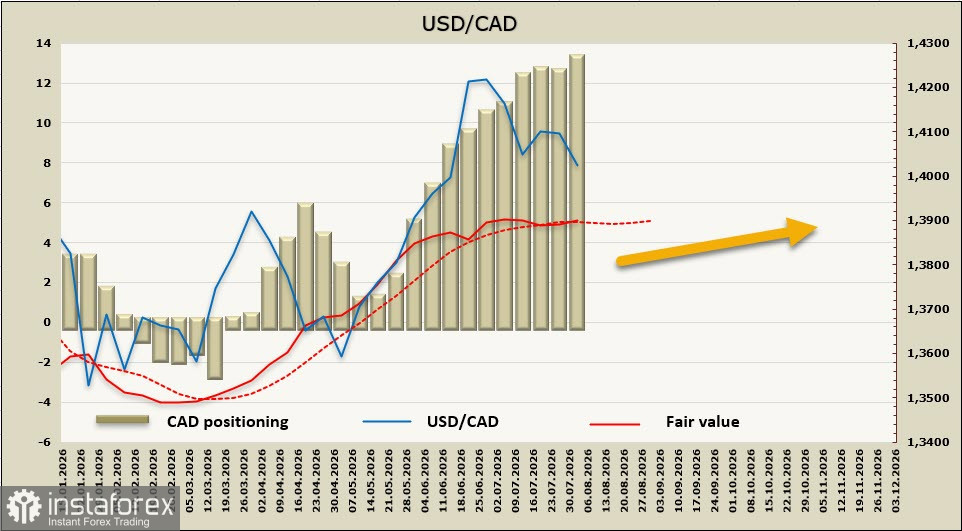
Despite the significant imbalance in positioning, the dollar continues to lose ground. The pair is likely to continue consolidating within the 1.4000–1.4100 range, and a breakout below 1.3990 will increase the risk of a decline to 1.3950/65. A return to 1.4125 is possible if the U.S. labor market shows results significantly better than forecasts on Friday.
The main risk to this forecast remains the trade conflict: if tariffs take effect on August 19, the Canadian dollar may receive further impetus to weaken, and the USD/CAD pair could return to a bullish trajectory.


